The 40 Hz gamma protocol
How to actually run a 40 Hz session — and why binaural is the worst way to deliver one.
Gamma — above roughly 30 Hz, with 40 Hz as the reference point — is the fastest band routinely discussed, and the one with the most interesting research attached. This is the practical companion to what the evidence actually shows: how to run a session, what hardware matters, and where the usual advice goes wrong.
Why 40 Hz specifically
Two reasons, and it is worth separating them.
The measurable one. A tone amplitude-modulated at 40 Hz produces the auditory steady-state response — a sustained, phase-locked electrical response first described by Galambos, Makeig and Talmachoff in 1981. It is among the most reliable measurements in auditory neuroscience, reliable enough to be used today as a clinical and pharmacological marker. If you want a rate with a well-characterised response behind it, 40 Hz is the strongest candidate in the whole spectrum.
The speculative one. Gamma activity is associated with binding — integrating separate features into a single percept — and is generated largely by fast-spiking parvalbumin-expressing interneurons that synchronise populations of pyramidal cells. The idea that driving this rhythm improves integrated thinking is plausible and largely untested in healthy adults.
Take the first as fact and the second as hypothesis, and you will not be disappointed by either.
The mistake almost every 40 Hz guide makes
Most guides give you a binaural recipe: 240 Hz in one ear, 280 Hz in the other, difference 40 Hz. The arithmetic is right. The advice is poor.
Binaural beating relies on the auditory system resolving a timing difference between the ears, and that mechanism has measured limits. Licklider, Webster and Hedlun established in 1950 that perception requires the two tones to differ by only a few tens of hertz — commonly cited as roughly 35 Hz — and works best with carriers between about 400 and 500 Hz.
A 40 Hz difference sits at or past the edge of where a binaural beat reliably forms at all. You are choosing the single most fragile delivery method precisely at the frequency where it is weakest.
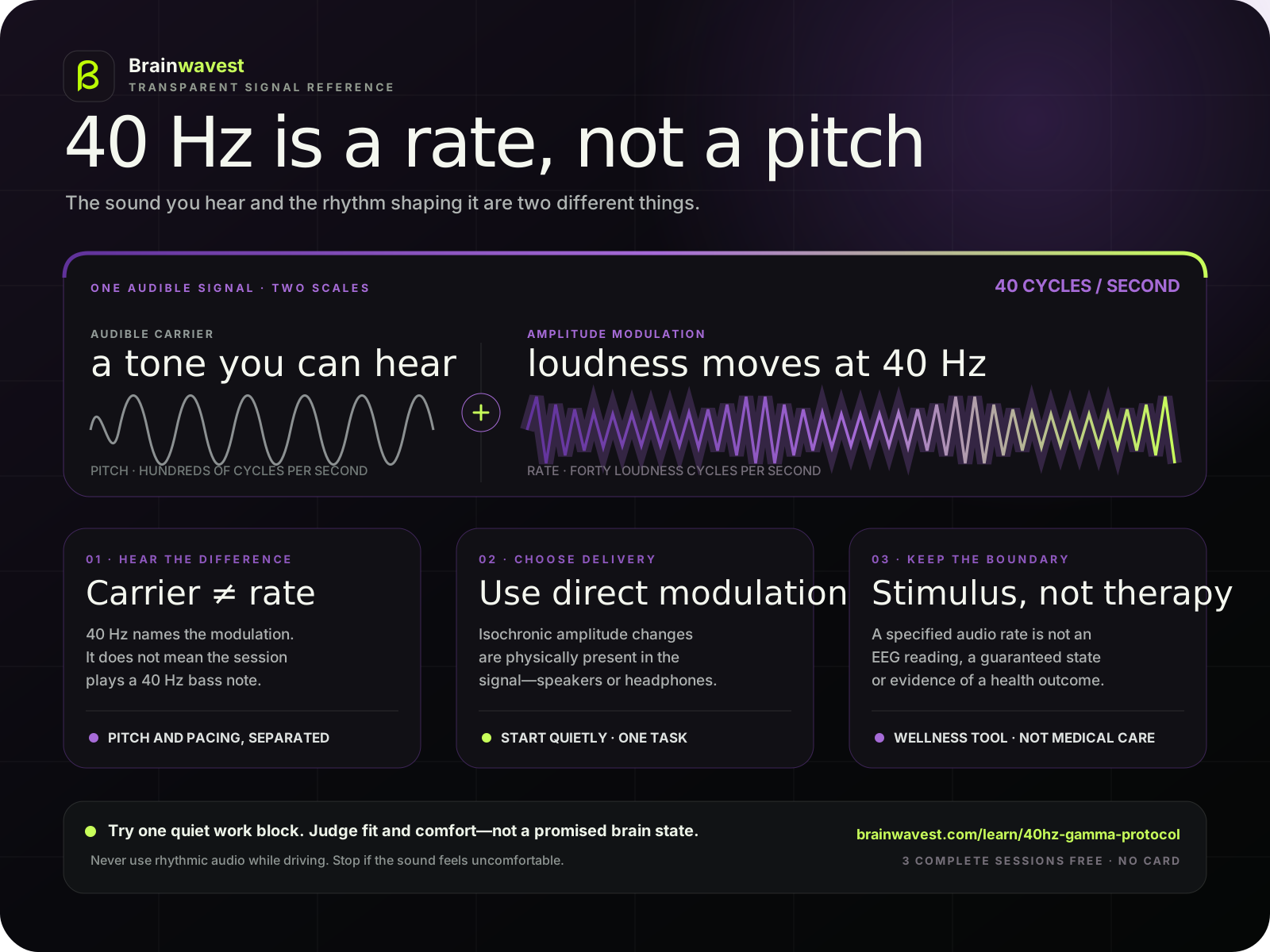
For 40 Hz, isochronic is the correct tool. The pulse is a real change in loudness, physically present in the air, and it is what produces the steady-state response the research is built on. It also works on speakers.
A correction on the physics
You will often read that binaural beats are necessary because you cannot hear 40 Hz.
That is not true. Human hearing runs roughly 20 Hz to 20 kHz, so 40 Hz is comfortably audible — a low bass note. Plenty of headphones reproduce it.
But it is also not what a 40 Hz session is doing. The session does not play a 40 Hz tone. It plays a carrier you can hear comfortably — in this catalog, between 80 Hz and 963 Hz — and modulates its amplitude 40 times a second. The 40 Hz is a rate, not a pitch. Confusing the two is the most common misunderstanding in this field, and it is why the "you can't hear it" explanation persists despite being wrong.
Hardware and setup
Headphones or speakers. For isochronic delivery, either works — the rhythm is in the signal. Headphones give you a cleaner low end and exclude the room, which matters if your carrier is low. See headphones or speakers.
Volume. Conversational level or below. Entrainment depends on timing, not loudness, and a level high enough to feel like a stimulus is high enough to be arousing in a way that works against focus. If you are straining slightly to hear detail, it is loud enough.
Audio quality. Ignore the usual advice about lossless files. Brainwavest generates every sample on your device as you listen — there is no file, no compression stage and nothing to degrade. On other platforms, ordinary streaming quality is more than adequate for a modulated tone; the claim that MP3 compression destroys entrainment is overstated.
Masking. A noise bed underneath makes a bare 40 Hz pulse far less fatiguing over a long block. Pink or brown works well. This is not merely cosmetic — the 2025 parametric study of gamma-frequency beats found the best attention results with a low carrier and white-noise masking.
The protocol
0–5 minutes — start before the work. Begin the session while you set up the task. Do not open email or messages. The point is to let the transition happen before the cognitive load arrives, not to layer audio onto an already-scattered state.
5–40 minutes — the block. Do the actual work: dense reading, code, analysis, drafting. One task. The session length is the block length, and letting the audio define the boundary is most of what makes a timed method work at all.
40–45 minutes — stop properly. Let the session fade rather than cutting it. Then take a real break away from the screen.
Cap the block. Forty-five minutes is a sensible ceiling for a first gamma session. If you get a headache or feel wrung out, that is a signal to shorten it or drop to a slower band — not to push through.
Sessions worth trying: 40 Hz Low-Noise Field at 18 minutes is a short first test. Deep Analytical Processing sits at 22 Hz — high beta rather than gamma — and is deliberately only 16 minutes. Flow State Gamma-Alpha Bridge uses phase-amplitude coupling: a fast gamma rhythm whose loudness is governed by a slower one.
What not to stack
Two additions get recommended in this space that we will not recommend.
Flickering light at 40 Hz. The MIT gamma work is predominantly audiovisual, and it is tempting to reproduce that at a desk. Do not. Photic stimulation in the 15–25 Hz region is the classic seizure-provoking range, and flicker more broadly carries real risk for photosensitive people — many of whom do not know they are photosensitive until an episode. Clinical protocols do this under supervision with screening. A light box on your desk is not that, and we do not ship one for exactly this reason.
Supplement stacks. You will find confident dosing advice pairing gamma audio with L-theanine and caffeine. We are not going to give you doses. It is outside what a sound company should be advising on, interacts with medication and individual tolerance, and none of it has been tested in combination with audio entrainment.
Contraindications
- Epilepsy or a seizure history, or photosensitivity — speak to a clinician before using rhythmic audio stimulation, and avoid photic entrainment entirely.
- Tinnitus — keep the level low and prefer lower carriers with a soft bed; a bright, bare tone is the least comfortable option.
- Acute anxiety — gamma is the wrong direction. Faster audio tends to compound an over-aroused state. Go to alpha first and come back. See audio for anxiety.
- Pregnancy, or a heart or neurological condition — speak to a clinician first.
Brainwavest is a wellness tool and not a medical device. It does not diagnose, treat or prevent any condition.
What this will not do
It will not clear amyloid from your brain. The microglial and waste-clearance findings that make 40 Hz famous are largely from mouse models, the human trials are small and ongoing, and the protocol under test is supervised, dosed and audiovisual. The evidence article covers exactly where that research stands and what remains unshown.
What a 40 Hz session reliably is: a well-characterised auditory stimulus, a defined block of time, and a reason to do one thing for forty minutes. That is a modest description and an honest one, and it is worth more than the alternative.
Try a session shaped for this guide
Listen quietly and judge it by whether it fits your routine—not by a promised outcome. Your first three complete sessions are free, with no card required.
40 Hz Low-Noise FieldGamma · 40 Hz · 18 min · IsochronicTry this sessionMore sessions from this guide
Every session publishes its full signal specification before you press play. Try the guide’s featured session, browse all sessions, or read the science page for the mechanisms drawn in full.